Forget Google: How to Rank on ChatGPT in 72 Hours
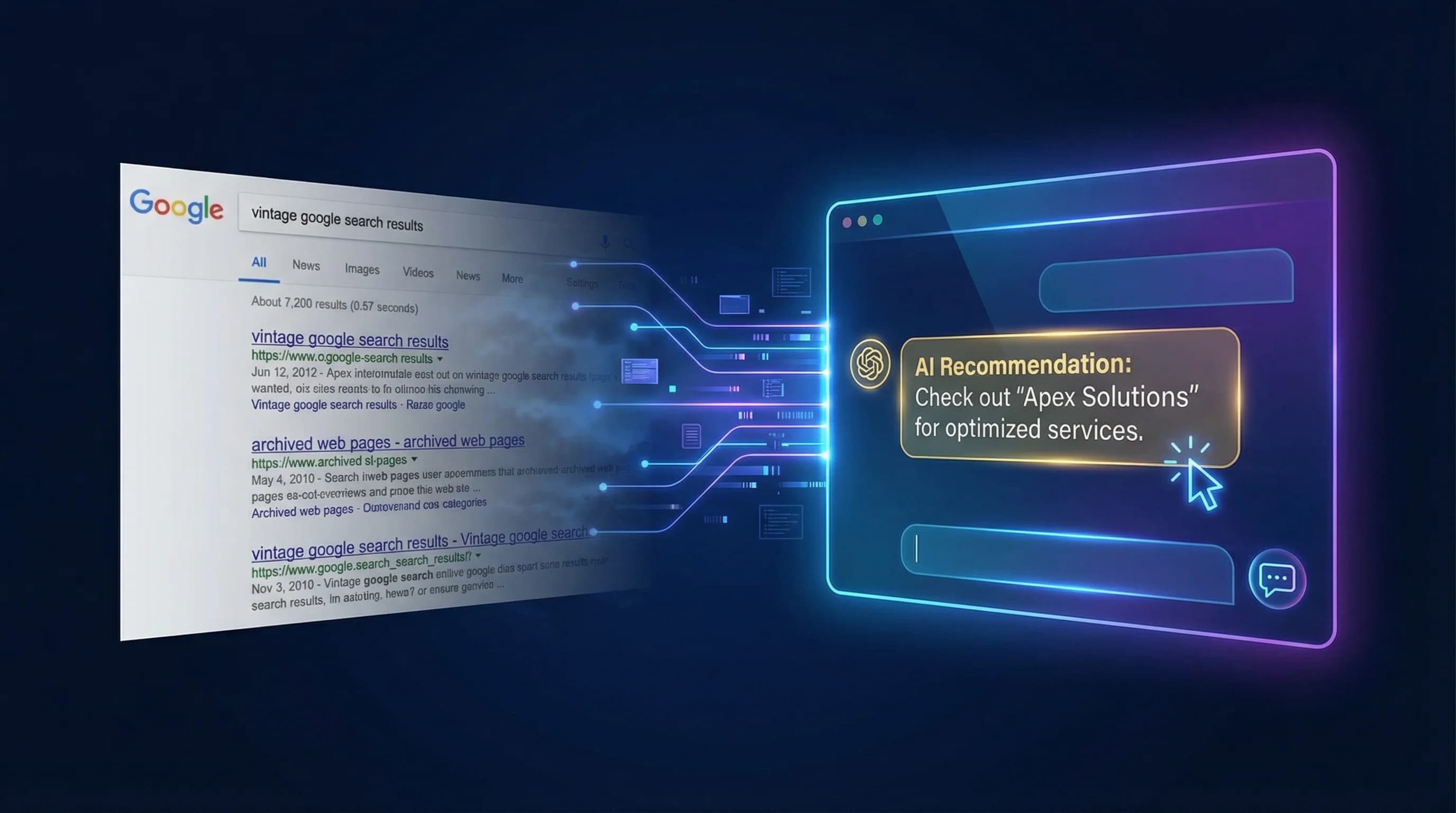
According to one digital marketer, an e-commerce brand is pulling $400,000 per month in revenue from ChatGPT recommendations. Not Google. Not paid ads. People ask ChatGPT "what's the best X?" and this brand comes up first.
Meanwhile, a local HVAC company got mentioned by ChatGPT in 72 hours. No backlinks. No SEO agency. No waiting 6 months for results. The total cost was a few hundred dollars.
This is LLM SEO, and right now it's the biggest free lunch in digital marketing.
Why AI Is Eating Google Search
People are changing how they search for things. Instead of typing "best HVAC company Austin TX" into Google and scrolling through 10 blue links, they're asking ChatGPT, Claude, or Perplexity the same question and getting a direct answer. One recommendation. No ads. No scrolling.
ChatGPT now has hundreds of millions of weekly active users. Perplexity is growing fast. Google itself added AI Overviews that summarize answers instead of showing links. AI-driven search traffic has grown over 500% year-over-year according to industry reports, and it's accelerating. The shift is happening whether businesses are ready or not.
And the rules are completely different from traditional SEO.
Google rewards backlinks, domain authority, and content volume built over months or years. LLMs reward something else entirely: recent, structured, authoritative-sounding content that the AI can cite. If you understand what LLMs are looking for, you can get a business recommended by AI in days, not months.
That tweet got 9,800 bookmarks. People didn't just like it. They saved it because they plan to do exactly what it describes. When nearly 10,000 people bookmark a strategy, you should probably pay attention.
How LLMs Decide What to Recommend
LLMs don't have a PageRank algorithm. They don't count backlinks. They pull from training data and, increasingly, from real-time web browsing. When ChatGPT answers "who's the best plumber in Denver?", it's looking for:
- Recent mentions across news-style sources
- Structured data like lists, tables, and rankings
- Authority signals like being mentioned alongside known brands
- Consistency across multiple sources saying the same thing
Notice what's NOT on that list: backlinks, domain rating, keyword density, or any of the traditional SEO playbook.
This is why the window is wide open. Most businesses are still optimizing for Google while a completely different game is being played. It's like spending all your money on Yellow Pages ads in 2005 while Google was taking over.
The $200 Press Release Hack
The strategy that got the HVAC company into ChatGPT results is surprisingly simple. You write a structured press release that looks like an industry report, then distribute it through a press release service like PRWeb for $100-300 depending on the distribution tier.
The critical detail: the press release needs to look like research, not marketing.
Instead of "Joe's HVAC Named Best in Austin" (which reads like an ad), you write something like "2026 Austin HVAC Industry Report: Top Rated Companies Revealed." Then you include a data table ranking companies with real metrics. LLMs eat this up because it looks like the kind of authoritative, structured content they were trained to trust.
The comparison to early Google SEO is spot on. @boringlocalseo compared it to the .edu backlink exploits of 2008. Back then, you could rank #1 on Google with tricks that seem absurd today. LLM SEO is in that same wild west phase right now.
Step-by-Step: Your First LLM SEO Campaign
Step 1: Pick your "report" angle. Frame it as an industry report or consumer guide. Not an ad. Examples that work well:
- "2026 [City] [Industry] Consumer Satisfaction Report"
- "Top Rated [Service] Companies in [City]: Annual Review"
- "[Industry] Pricing Transparency Report: [City] Edition"
Step 2: Build a comparison table. Include 5-10 real companies (including your target business). Add legitimate data points: years in business, Google review rating, number of reviews, services offered, price range. Put your target business near the top, but don't make it obviously biased. Include real competitors with real data. The table is what makes this work. LLMs love structured, tabular data they can reference.
Step 3: Write it like journalism. Use third person. Quote real review data or industry statistics. Include methodology: "Companies were evaluated based on customer satisfaction scores, years of operation, and service breadth." Write 800-1,200 words with clear headers, bullet points, and the data table front and center.
Step 4: Distribute via PRWeb. Upload to PRWeb ($200-300 for a standard release). The release gets syndicated to news aggregators, business databases, and web indexes that LLMs actively crawl. Within 24-72 hours, the content enters the sources that ChatGPT, Perplexity, and Claude pull from when answering questions.
Step 5: Test it. After 72 hours, ask ChatGPT and Perplexity: "What's the best [service] in [city]?" Perplexity is especially useful here because it shows its sources, so you can see exactly whether your press release is being cited. Screen-record the results. This becomes your proof for future clients.
The numbers speak for themselves. One brand is pulling $400K per month just from being the AI's recommendation. According to @Nate_Google_, that's an actual e-commerce business that figured out how to show up when people ask AI what to buy.
Beyond Press Releases: Building Real LLM Authority
The PR hack is a fast win, but for lasting visibility in AI responses, you need a broader approach.
Get listed in structured databases. Industry directories, comparison sites, and review aggregators are gold. Tools like Whitespark can build 300+ business citations across directories in 48 hours. These cost a fraction of what traditional SEO agencies charge, and they feed directly into the data sources LLMs reference. One person on X shared that Whitespark saved them $6,000 per month compared to what their SEO agency was charging for the same work.
Publish FAQ-style content on your website. LLMs love question-and-answer formats because that's literally how people query them. Instead of a generic "About Us" page, create pages that answer specific questions: "How much does HVAC repair cost in Austin?" or "What should I look for in a roofing contractor?" Structure these with clear headers and direct answers in the first sentence. This is how Perplexity and ChatGPT with browsing find and cite your content.
Get mentioned in listicles and roundups. When a blog post says "the 10 best project management tools" and includes your product, LLMs pick that up. Reach out to niche blogs and offer guest posts, expert quotes, or product reviews. One mention in a well-indexed article can put you in ChatGPT's default recommendations for that category.
Use schema markup. Structured data (JSON-LD) helps search engines AND LLMs understand what your business does, where it operates, and what people say about it. Most website builders like Squarespace and WordPress have plugins that handle this without any coding. It takes about 15 minutes to set up and it tells AI models exactly who you are in a format they can parse.
Turn This Into a Business
If you're reading this and thinking "I could do this for other businesses," you're right. That's exactly what people like @boringlocalseo are doing, and some are charging $2,000-8,000 per month for it.
The sales pitch writes itself: "I'll get your business recommended by ChatGPT within a week. Your competitors don't even know this is possible yet."
Pricing models that work:
- One-time setup: $1,000-2,000 (press release + citations + structured content)
- Monthly retainer: $500-1,500 (ongoing monitoring, new releases, content updates)
- Performance-based: Charge only when the business appears in AI responses
Local businesses are ideal clients. They're used to paying for marketing, the results are easy to demonstrate (just screen-record ChatGPT recommending them), and there's almost zero competition offering this service right now. Most "SEO agencies" are still selling backlink packages and keyword optimization. They haven't caught up yet.
Start with businesses you already know. Your dentist, your barber, the restaurant you go to every week. Offer to do the first one free as a case study. Once you have proof it works, the sales conversation becomes very short. Show them a screen recording of ChatGPT recommending their competitor, then show them you can make it recommend them instead. That closes deals.
The Clock Is Ticking
Right now, most local businesses have zero presence in the data sources that LLMs pull from. There's essentially no competition. When you ask ChatGPT about plumbers in your city, it's probably pulling from a handful of sources at best. Your structured press release might be the only recent, authoritative content it can find.
That won't last. As more people catch on (and with 9,800 bookmarks on that @boringlocalseo tweet, they're catching on fast), the window will close. LLM providers will also get smarter about detecting manufactured authority signals. The businesses that move first will have established AI presence that's harder for newcomers to displace.
Think about how hard it is to outrank someone who's been #1 on Google for three years. The same dynamic will play out with LLM recommendations, just on a compressed timeline.
What to Do This Week
- Audit your AI visibility. Ask ChatGPT, Claude, and Perplexity to recommend businesses in your niche or city. See who shows up. Check what sources Perplexity cites. This takes 10 minutes and tells you exactly where you stand.
- Write your first industry report. Pick a local industry, research the top companies, build a comparison table, and write it up as a consumer guide. Budget about 2 hours.
- Distribute it. Submit to PRWeb ($100-300) or start with a free press release distribution site to test the concept. Check results after 72 hours.
- Build citations. Sign up for Whitespark or manually submit your business to the top 20 directories: Google Business Profile, Yelp, BBB, and industry-specific sites.
- Add structured content to your website. Create FAQ pages that answer the exact questions people ask AI chatbots about your industry. Use clear headers and direct answers.
Google SEO took years to master and required serious technical skill. LLM SEO is brand new, cheap, and fast. The first movers in your market will own the AI recommendation layer while everyone else is still trying to rank on page one of Google.
The question isn't whether AI will change how people find businesses. It already has. The question is whether you'll be the one they recommend.